reduction in emissions intensity of GDP from the 2005 level
Updated NDC ↗Carbon intelligence for Indian business
India’s net-zero
economy needs
a ledger.
Turn electricity bills, fuel use, logistics and supplier activity into a traceable greenhouse-gas inventory—ready for decisions, disclosures and credible reduction plans.
The policy signal
Net zero is a national direction.
Measurement is the operating system.
India’s climate framework is moving from national ambition toward sector targets, disclosure, assurance and carbon-market mechanisms. Company-level inventories make that direction actionable.
non-fossil share of installed electric power capacity, crossed in June 2025
Government update ↗India’s stated target year for economy-wide net-zero emissions
Long-term strategy ↗National direction
NDC + 2070
Economy-wide targets set the direction for capital, technology and energy choices.
Market mechanism
CCTS
India’s Carbon Credit Trading Scheme establishes compliance and offset mechanisms.
Read the scheme ↗Corporate disclosure
BRSR Core
SEBI’s framework connects sustainability metrics with assurance or assessment. Its 2025 update also revised value-chain disclosure provisions.
View the updated framework ↗India’s 2070 goal is a national commitment, not a universal corporate deadline. CCTS obligations apply to notified entities; disclosure duties depend on the entity and current rules. Installed capacity is not the same as electricity generated.
Why carbon accounting
You cannot reduce what you cannot locate.
A net-zero promise is a destination. A greenhouse-gas inventory is the map: it shows where emissions sit, which data supports them, and whether reductions are real.
“Carbon data should work like financial data: bounded, sourced, reviewed and comparable over time.”
Bharat Carbon Ledger principle
Set the boundary
Define companies, facilities, periods and operational control.
Capture activity
Record energy, fuel, travel, freight, materials and other business activity.
Apply the factor
Connect quantities to documented emission factors and calculation versions.
Review and improve
Find hotspots, assign actions and preserve the trail behind every number.
The emissions map
Three scopes. One connected footprint.
Use the GHG Protocol scopes to separate direct operations, purchased energy and the wider value chain.
Inside your operations
Choose a numbered source to explore
01 / DIRECT SOURCE
Fuel combustion
Fuel burned in your boilers, furnaces or generators releases greenhouse gases directly at your facility.
Data to collectFuel type, quantity and purchase or meter records.Scope 01 · Direct emissions
Emissions from sources your company owns or controls.
Start with the operations closest to you—the fuel burned, processes run and gases released inside the organisational boundary.
- Stationary combustion
- Owned or controlled vehicles
- Process emissions
- Refrigerant leakage
Explore a reduction pathway
Move the levers.
See the footprint change.
A credible plan starts with a measured baseline and reductions across all three scopes. Try this fictional 1,000 tCO₂e inventory.
ILLUSTRATIVE PLANNING SANDBOX
Efficiency, electrification and process changes
Lower demand and cleaner purchased energy
Supplier engagement, logistics and product design
Remaining emissions1,000tCO₂e / year
Scope 1Scope 2Scope 3Reduced
0% below the illustrative baseline
What makes it net zero?
Deep emissions reductions come first. Residual emissions require appropriate carbon removals under the chosen framework. Buying offsets alone does not demonstrate a net-zero pathway. Explore SBTi’s net-zero framework ↗
This sandbox applies simple percentage changes, not emission factors or a verified forecast.
Bharat Carbon Ledger
From scattered evidence to one accountable record.
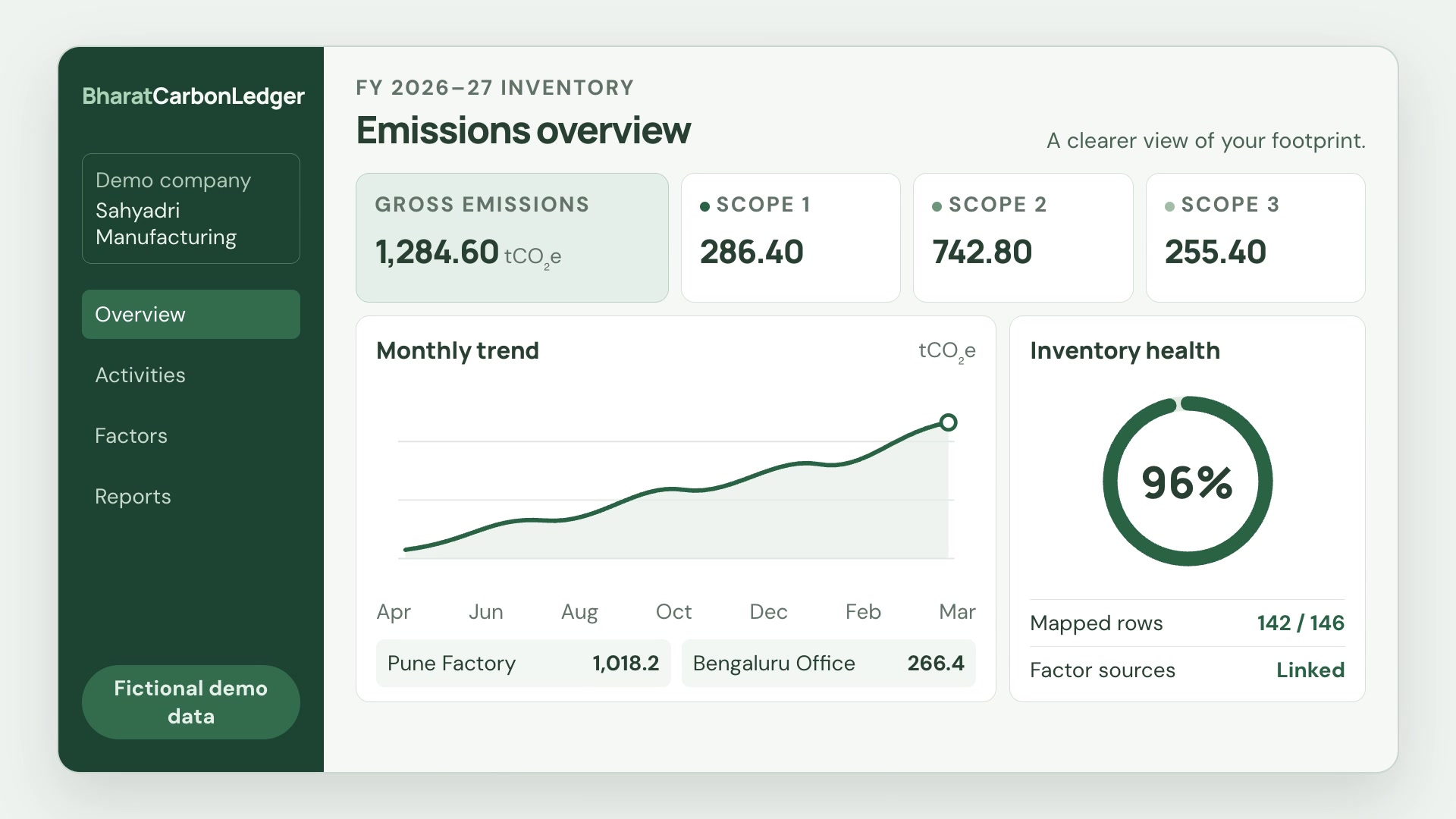
A multi-company carbon accounting workspace for Indian-registered businesses—designed around the people, facilities and source documents behind the footprint.
Product preview · Production factor sources and licences require review before final reporting.
See the product01
Companies, facilities and teams
Keep organisational boundaries explicit with facility-scoped roles and isolated company workspaces.
02
Activity to result
Connect every calculation to activity data and a versioned factor source.
03
Excel without the ambiguity
Preview uploads, fix exceptions and confirm clean records atomically.
04
Review trail
Attach evidence, submit for review, reopen when needed and preserve history.
05
Reports people can use
Move from dashboards to PDF and XLSX snapshots for internal review and disclosure workflows.
Voices from India’s energy transition
The direction is shared.
The work is operational.
MA“
Our goal is to become Net Carbon Zero by 2035.
SS“
We have to develop new technologies to lower emissions and remove carbon from the atmosphere.
GA“
While net zero targets are much needed, a company’s sustainability initiatives must be aligned with the nation’s sustainability goals.
Public statements reproduced for context. These leaders and organisations do not endorse Bharat Carbon Ledger.
Start with the record
Every net-zero journey begins with a number you can defend.
Build the boundary. Bring the evidence. Account for every tonne.
Open Bharat Carbon Ledger